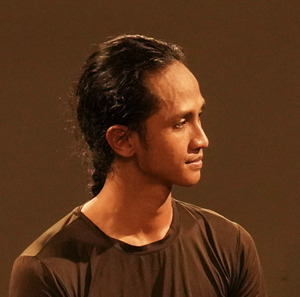
The Distance Between City and Kitchen: “The Kitchen Under Skin” Kenta Masukawa
Documentation of Studio Plesungan. Photo by Jauhari
Klik di sini untuk mengakses artikel dalam Bahasa Indonesia (borobudurwriters.id)
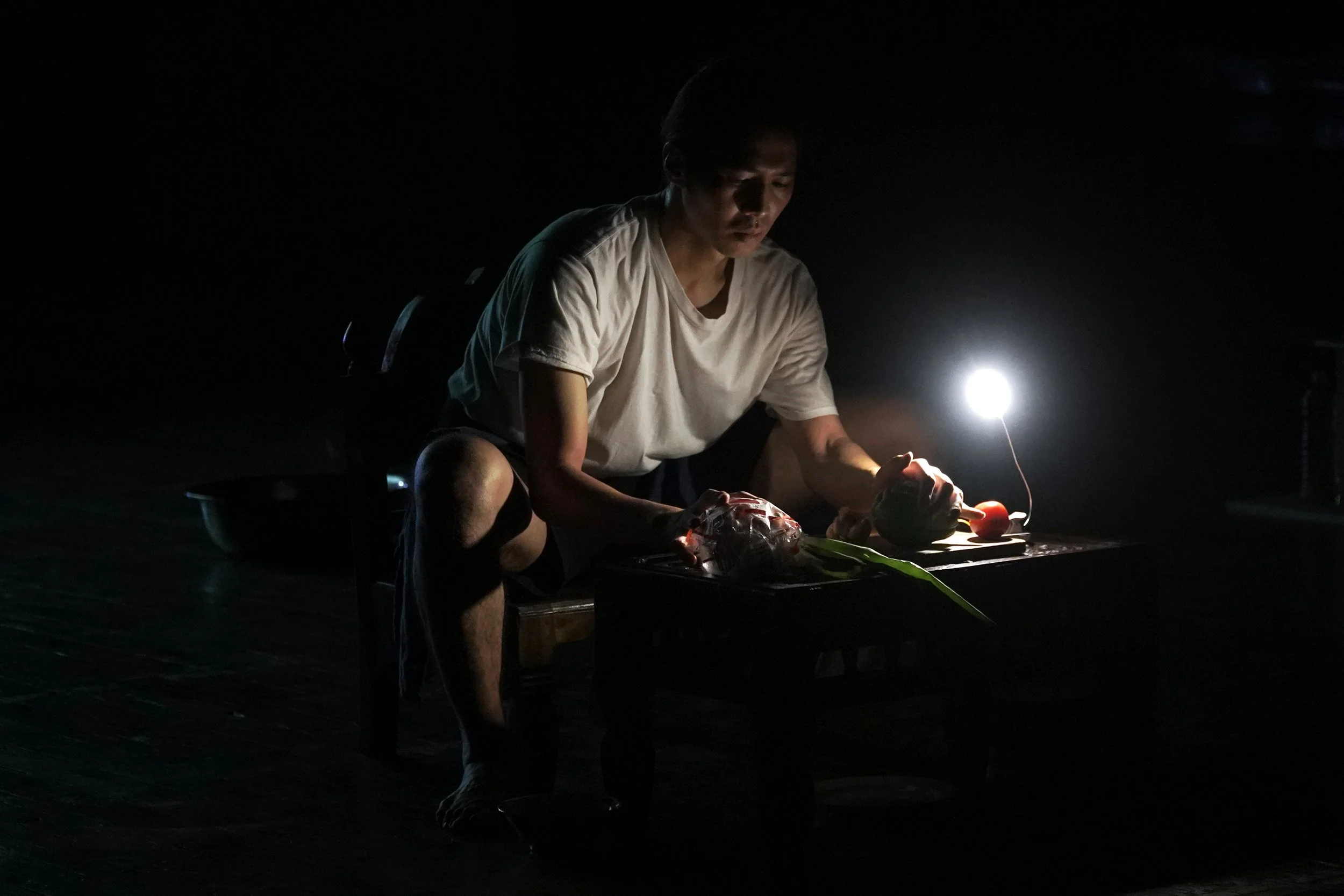
The dim stage lights illuminated Kenta, intimate with his ingredients and cooking utensils. He walked silently across the room, toward the stove in front of him. He gently touched the pot perched on top. Carefully, he felt its contents, then slowly squeezed the moist grains of rice.
On a screen hanging vertically at the center back of the stage, the words "Resep Koreografi (Choreography Recipe)" were displayed. The text was a direct projection of a recipe sheet lying on the table. The recipe not only served as a guide for the cooking process but also as a path that guided Kenta's body through the performance space, embodying the choreography he had titled "The Kitchen Under Skin."
The recipe consisted of six pages of text, complete with a cover page and a closing page. This wasn't the first time I'd seen the text, as the translation process was collaboratively carried out by Verina and me. Throughout the process, Kenta had used the recipe as a guide in his practice. He had probably gone through the process dozens, if not dozens, of times.
He was as diligent as he was in his rehearsals, but in his performance, he didn't display any "skill." As skillfully as Mrs. Sisca Soewitomo demonstrates cooking on television, or as a chef demonstrating his dexterity in a street food stall or restaurant, in this work, Kenta embodies a foreignness. He appears unfamiliar with everything on stage that he previously arranged himself. His performance resembles an attempt to remember and reacquaint himself with these objects. But what else lies beneath the grains of rice and the softness of the tofu?
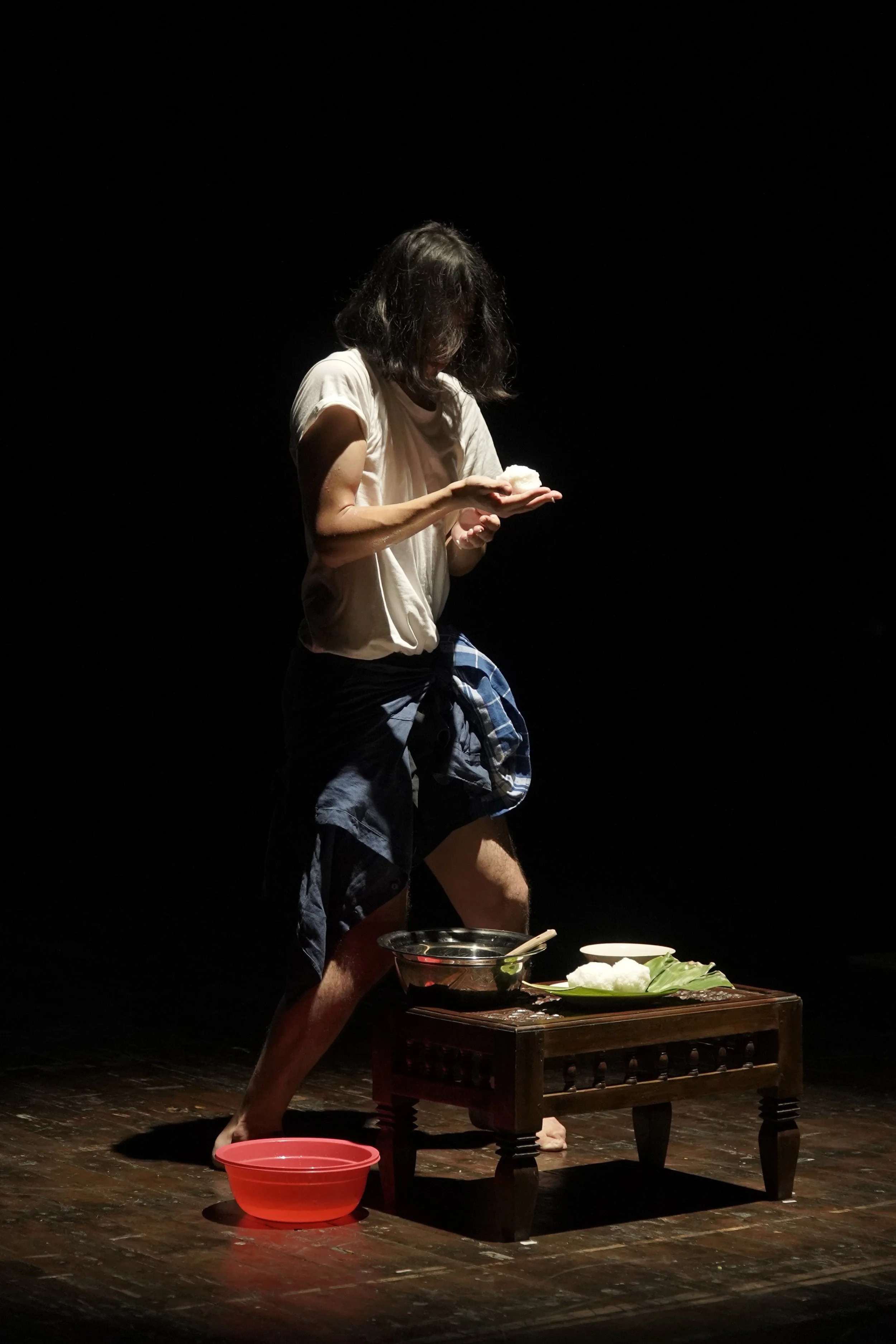
Kenta Masukawa's performance "The Kitchen Under Skin," presented in the On Stage program on January 10, 2026, is a choreographic work based on a recipe. The piece invites the audience to experience the entire cooking process over the course of an hour and a half. From the moment the rice is washed, no steps are skipped. Kenta begins by arranging the ingredients and equipment, pouring water into the pot of rice. Then, he proceeds with each step, one by one, such as chopping vegetables or stirring eggs and tofu. Everything is done with such solemnity that the small table in front of the stage is slowly filled with dishes that "become" part of the performance.
The performance, held at the Teater Arena of the Central Java Cultural Park, culminated in Kenta's residency program in Solo, a collaboration between Kyoto Art Center and Studio Plesungan. The residency provided a space for Kenta to develop his creative process, which focused on creating movement notations based on cooking recipes. He drew on cooking practices and gestures as inspiration for composing the choreography, which then guided his body movements throughout the performance.
Watching both the show and the research process made me ponder a seemingly simple, but always difficult to answer, question: where does the food we eat come from?

Documentation of Studio Plesungan. Photo by Jauhari
The Distance Between the City and the Kitchen
Kenta became interested in cooking after graduating from college and leaving his parents' home to work and live on his own. Growing up in Tokyo, his life was spent outside the home. During his office days, he spent his time navigating the hustle and bustle of the commuter trains from early morning, then spending hours on the 14th floor in front of his computer, then returning to the bustle of the city at nine at night. During this time, Kenta began to discover the process of cooking as a meaningful experience. Through the process of watching the ingredients combine in the pan and watching their shape change over time, he felt his fingers begin to taste the fascinating experience within him.
Cooking became a moment to reflect on how modern life can distance the body from the essence of "nature" as a reality connected to our existence as living beings. The complex urban system often makes Kenta forget that there is another reality beyond that routine. The practice of cooking restores the body to a reality beyond the city system.
For me, observing the phenomenon between Kenta and cooking reveals the veil that conceals the distance we forget to measure: between the city and the kitchen. The vastness of the city creates not only physical distance but also a psychological distance that separates the body from the kitchen. This distance creates bodies that are unfamiliar with the kitchen and the practice of cooking. However, city dwellers' inability to cook is often not simply "laziness," but rather conditioned.
Every day, those in big cities are required to wake up earlier, travel longer distances, and return home later, all for a meager salary. This leaves little time and energy for cooking. The opportunity to stay at home longer and do domestic work is now considered an increasingly expensive luxury. As more people are unable to cover living expenses, more and more are forced to work late into the night. Kitchens become empty because there is no longer time to "burn" simply to heat the pot and cook simple meals for the family.
As someone born and raised in Jakarta, moving to Solo brought me closer to the kitchen. Time became more present because it wasn't restricted by travel distance, and the community was more flexible in its understanding of time. I then had the opportunity to engage in other human activities, one of which was cooking. My time at Studio Plesungan helped me connect physically with the kitchen and cooking, something I'd never experienced at home. When I started renting, I had the opportunity to become more familiar with the kitchen. So, I began redefining the meaning of home, and then placing the kitchen within it.
Documentation of Studio Plesungan. Photo by Jauhari
"Becoming" Body / Cooking
Kenta did not undergo formal studies at a dance or performing arts academy. His encounter with dance came through his participation in extracurricular student activities while he was in college. During this time, he witnessed a contemporary dance exhibition at the Theatre Museum, Waseda University, and saw documentation of a performance by Min Tanaka. This documentation piqued Kenta's curiosity, as he was initially drawn to dance as a phenomenon that embodies the experience of texture and sensation, rather than an attempt to memorize and perfectly execute a series of movements.
Kenta's interest in butoh continued, as he read various books, interviewed practitioners, read about butoh-fu, and then experimented with the movements himself as part of his learning process. After delving deeper into the world of performance and presenting his own work, he studied directly with butoh practitioners. Upon moving to Kyoto, he studied with the veteran butoh artist, Tenko Ima. In my interview with Kenta, he explained that he was interested not in preserving butoh from a traditional perspective, but rather in its workings and the mechanisms of exploration. For him, studying butoh helped him absorb the ideas and thoughts of pioneers like Hijikata Tatsumi and Ohno Kazuo, while exploring and asking: what kind of body and performance are needed today?
Watching "The Kitchen Under Skin," butoh presents an interesting aspect of Kenta's work. While it's clear that some of Kenta's movements are inspired by traditional butoh forms, he doesn't focus solely on aesthetics, but rather absorbs them as a method of bodily work. Butoh becomes a tool that opens up opportunities for Kenta's body to process the act of cooking as a transcendental experience.
As the soup slowly boils and evaporates, his body is given the opportunity to experience a process of sublimation. Kenta absorbs butoh's workings to condition his bodily presence, experiencing the simultaneous changes between the ingredients and his body, while simultaneously releasing both from their physical shackles.
His body opens itself to the changes occurring in the food, tasting with his skin and all his senses. During the performance, Kenta doesn't taste with his tongue. It seems he wasn't seeking sensations perceived by the sense of taste, as most people do. He was seeking another sensation, a taste experience that would trigger his body to make a decision about movement. This stage occurs as the body's process of capturing the taste experience that triggers decisions about movement and behavior.
The performance "The Kitchen Under Skin" presents the process of "becoming" that occurs simultaneously during cooking: the body and the food. Cooking is no longer about fulfilling the desire to consume, but rather an event of transformation. The performance creates an in-between experience resulting from the transitional moments that are fully displayed.
--
The series of moments in Kenta's performance can be traced to one harsh reality: the unknown that stretches the gap between the modern body and the food we put into it. Where do the ingredients come from? What are their conditions during their journey? What is the process of making them? What is put in with them? How are they stored and transported before being spooned into our mouths, finally chewed and swallowed into our stomachs?
In the past, none of these questions even occurred to me because time was consumed by the two-hour commute between my home and work. The quiet space of Kenta's performance allows us to hear something that was previously obscured by the noise of traffic. Kenta crafts a recipe that enlivens his body to create an experience that addresses that unknown. This performance presents a piece of tofu, from which we now learn a piece of history.

Recipe Choreography
The performance embodies "Choreography Recipe" (which somehow I feel “Recipe Choreography” works better) as a movement score in the form of a cooking guide. The recipe is not presented in mathematical language, using tablespoons and teaspoons as measurements. Instead, he constructs the recipe into a poetic world. The recipe includes pragmatic guidance, surrounded by poetic imagery that evokes sensory memories. This approach brings to life the body's function as a receptacle for memory, recalling those memories as triggers for feelings that move the body.
Time is not presented as compartments of duration. It is unfolded as a space that gives Kenta's body the opportunity to receive and remember, then channel those memories as a force that is responded to by the nerves that ignite the body to move. Throughout this process, time is stretched further, allowing Kenta to become aware of each of his bodily decisions and the consequences of those decisions. In this process, the recipe does not become a holy book to be obeyed without pause for interpretation; it becomes butoh-fu that ignites Kenta's body to discover its own meaning through the experience of movement.
In the performance of "The Kitchen Under Skin," I saw Kenta's attempt to pay attention to something beyond himself. He wasn't dominating the stage, but rather positioning his body to be influenced by the softness of the tofu and egg and the simmering miso sauce, as well as the warmth of the freshly cooked rice in his palms. He wasn't present above the tofu and egg and rice balls, but rather with an awareness that his existence intersects with all the materials that coexist with him.
Kenta confronts his ignorance alongside the audience. Kenta's bodily attention to the tofu requires the audience to shift their attention from themselves to the tofu. The audience cannot cling to the narcissistic assumption that this performance will entertain them, because Kenta's presence on stage isn't built on the narcissistic assumption that the audience comes to be entertained by his performance.
Silence embodies Kenta's process of confronting his own ignorance, as that ignorance opens up an opportunity to experience the process. I find this experience increasingly rare in contemporary performances today. Often, the body presents itself as an entity that "already knows" and is full of confidence. However, often that apparent confidence is merely a shell that masks the emptiness within, because the body doesn't actually know the reason that drives it to move. Confidence is also often so bright that it masks the emptiness within the audience. I enjoyed "The Kitchen Under Skin," which boldly opened up a space for doubt, slowness, and ignorance.
Despite the various artistic and executional flaws in "The Kitchen Under Skin," I interpret it as an offer to question the existence of bodies facing the turning wheels of industry (performing arts), which are often forced to maintain a solid, hard, and resilient surface to avoid being crushed by progress. The body, which must appear convincing, constantly attracts attention and maintains the image projected outwardly, thus depriving itself of space for questions and opportunities to experience itself. We can reflect on why movement is no longer a process of discovery, but rather a means of proving that one has "arrived" and presented as a "ready-to-eat" product. I believe this reflection is useful for recognizing humanity's current relationship with modern anxieties: the anxiety of being perceived as inadequate and left behind.
The performance is not a transaction of satisfaction, but rather an event that opens awareness to the distance between modern humans and the processes that sustain their existence. The gradual connection of gestures and stages in this work suggests the disconnection of modern humans from many things: the kitchen, the family, even their own bodies, which are disconnected as burdens, slowing them down from their journey towards the modern.
"The Kitchen Under Skin" offers the kitchen as a space to restore the body's connection with the world. Perhaps what is missing from our lives today is not just the ability to cook, but the ability to be present in the process, without rushing to produce ready-to-eat images, ready to be consumed.