The Crisis of Inner Space
Klik di sini untuk membaca artikel versi bahasa Indonesia
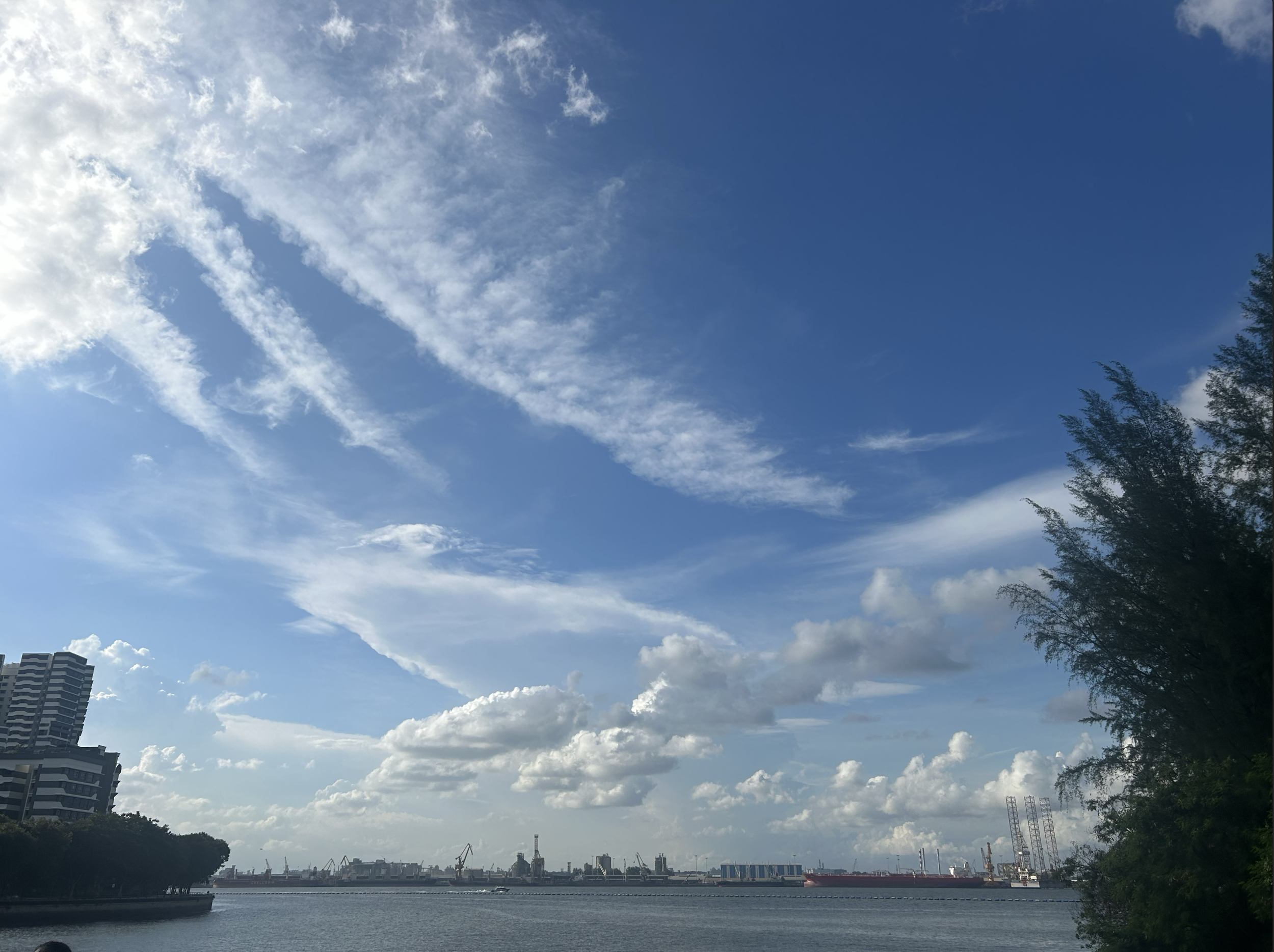
The performance "A Place We Could Not Name," which I collaborated on with Xue and Mervin Wong, concluded its five-week residency on August 23, 2026. It felt like a momentary relief, but as the moon began to rise, a ripple of questions flooded my mind. As I walked among the bright lights of the building, I engaged in contemplation. This contemplation became a stream that not only reflected the performance but also extended into a river. My thoughts traveled along the river, connecting the performance to the worlds that made it possible.
In this performance, we engaged the audience in movement, following two "guides," Xue and me. The performance seemed to go well, but I sensed a problem in how public engagement was understood. I saw the engagement offered slowly building barriers within the audience, creating exclusivity. The full experience belonged to those directly involved, while the presence of the audience, who were not directly involved, was disregarded. It was as if the work spoke only to those within a specific circle of experience.
This, in turn, raised another issue. The actions carried out remain centered on the figure of the leader, someone to be followed. The public experience ultimately pivots on the act of "following," but remains weak in the possibility of constructing a poetic experience for the audience present, offering a different perspective on reality. When works continue to rest on the relationship between leader and follower, they risk falling into an authoritative system.
The patterns created by this leader-follower relationship often focus on circular forms, centered on the leader. Events spiral into a pseudo-ritual or pseudo-therapeutic impression: presenting a ritual aesthetic devoid of function and transformation. This was unsettling for me, even while I was at the performance.
My thoughts rising, I slowly waded into the body of water. With my feet beginning to tread mud, I waded deeper to follow the current that had carried me downstream of my anxiety. I dipped my face in the current to discover that there were more fundamental differences in how each of us understood artistic creation.
Throughout the residency process, I felt that creation had become too quickly oriented toward product and form. Various forms continue to emerge, affixed one after another, while the core idea that should be the source of their growth is never truly agreed upon. What grows is not an organism, but a shell that continues to expand. New forms emerge without any roots connecting them to an inner need. This impression only becomes stronger when I try to understand where these forms actually come from.
--
Between Art-Making and Shopping
One of my goals during this residency was to find the core idea, or what I often refer to with Xue and Mervin as the “core sense” of the work. What feelings, experiences, or perceptions can we agree on that drive us to create this work? I feel this is crucial as the seed from which the work grows. One challenge I faced was when Xue said she “has no feelings.”
Both in a conversation during the residency and later in the discussion session, Xue stated that she currently has no feelings. During that conversation, I asked her, “If you say you can’t ‘feel,’ then where do the materials for your work come from? How do you choose the shapes, forms, or shapes you incorporate into your work?”
She replied, “Usually, the material emerges when I find something ‘funny.’” I continued, “Is ‘funny’ a feeling?” She replied, “No. I mean, something interesting.” The conversation continued to spiral until I asked, "If forms of art are chosen simply because they find something interesting, then what's the difference between creating art and shopping?"
He replied, "Yes, sometimes I see the process of creating art as a bit like shopping."
I was quite stunned by this, and this sentence continued to haunt me.
I realized that we might be using the word "feeling" in different senses. When I asked about the origin of a form, I was looking for an experience that transforms one's body. When he answered "something interesting," I began to wonder if we were talking about two distinct ways of understanding art practice.
Could there be a situation where "interest" no longer stems from a long engagement with something, but instead becomes simply an act of "picking"? I began to see this phenomenon in various contemporary art practices, where materials are chosen not because they connect with the maker's life experience, but because of the "potential" of beauty they can produce.
I questioned this out of suspicion that this was repeating the past mistakes of cultural colonization. When art, built on a consumerist mindset, transforms into an activity of collecting various forms, experiences, objects, or aesthetics deemed interesting and then crafting them into works of art, colonialism often operates subtly through the desire to take something from another place because it is considered interesting, unique, or valuable. Whether it be an object, a ritual, a landscape, a story, or even the human body, this desire is ingrained and passed down from generation to generation, settling in the subconscious. It's worth asking: if artists appropriate certain cultural practices, traumas, spiritualities, or identities simply because they are considered artistically appealing, are we replaying the subconscious memory of colonialism in a more subtle form? This experience was disturbing, but powerful enough to make me see that the problem I was facing was not simply consumerism in art, but something more fundamental: the desire to absorb, creating an extractive art practice.
--
The Art of Extracting
During my residency, I sought to explore this experience and gain a broader perspective. Today, many artists seek to discover their roots through an autoethnographic approach. They trace their ethnicity, seek out local knowledge, and then build their work from there. Another common approach is for artists/art practitioners to collaborate with artists possessing certain "cultural assets" to legitimize their work on their chosen topic. While this may seem like an interesting and exciting trend to follow, I believe both approaches harbor complex issues, as they contain an often-unconscious desire for exploitation.
I began to ask myself, what kind of world creates this kind of contemporary art production regime? Why do these "extractive" practices feel so commonplace?
By "extractive," I don't mean simply taking references, as I believe all practitioners have them to some degree. The problem arises when the relationship with something stops at the process of extraction. A ritual is learned solely for its aesthetics. A life experience is approached solely to produce artistic material. The relationship is no longer about allowing oneself to be transformed by something, but about transforming something into one's own.
I believe this art of absorption is also different from exchange. In exchange, relationships are built through attachment. In art that absorbs, the primary motivation is to take something from a place without truly establishing a relationship with it. The objects of absorption can be bodies, landscapes, stories, rituals, trauma, or even the aesthetics of resistance. Like colonialism that took spices, art today often draws on lived experience as a resource. The logic remains intact even though the objects of absorption change. A simple phrase like, "Ah, this is interesting," can secretly harbor another motivation: "Ah, this is interesting to absorb."
Even performances that claim to be public participation are not entirely free from this issue. Is our public engagement also a form of absorption? Are these public bodies merely used to produce certain images without consensus, to strengthen the work? Does their involvement truly offer them a transformative space, or merely serve as artistic material to enrich the presentation? If so, art that absorbs is slowly losing its motivation to seek out lived experience. These questions then lead me to another issue that feels increasingly fundamental: the crisis of inner space.
The Crisis of Inner Space
Initially, I thought this issue only ended with the creative process, but the more I explored it, the more I reached the source of this long current. I realized that the phenomenon in this work was the tip of the crisis of inner space as a cultural and societal condition. This crisis of inner space isn't just about personal emotions; I'm referring to the body's ability to sediment experiences until they transform how one views the world. These sediments become the fertilizer for the work to grow.
Today, almost everything is geared toward performance. We live in a culture that continually encourages externalities: being seen, published, exhibited, performed, and produced. The urge to perform grows far faster than our ability to cultivate inner space. The body is slowly turning into a surface, losing its ability to sediment experiences. Artistic material is no longer born from the body's relationship with the world, but only from what adheres to its surface. It's no surprise now that many works feel large but lack density. Rich in references but poor in experience.
Standing before this water source, I slowly settle into the question of whether today's artists are still creating? Or are they actually just curating? I floated away from the water source and saw an animal come to drink. Its skin was like an artist's sheep's wool, but when its tongue stuck out, it revealed gleaming curatorial fangs.
A Curatorial Wolf in Artist Sheep Fur
Artists today gather whatever resources are considered valuable, collecting them and arranging them with care, like rows of sardine cans displayed on supermarket shelves or floral arrangements decorating a hotel lobby.
Art no longer stands upon lived experience; it stands upon an arrangement of aesthetic references.
Today, the curatorial function is gradually overtaking the creative one. Artists still create, but the creative process increasingly begins with selecting, connecting, and arranging materials that already exist. The question, then, is not whether curation itself is flawed, but rather: at what point does the act of choosing replace the act of experiencing? Could this be something we have unconsciously absorbed from the logic of social media algorithms?
Algorithms do not generate experience. They simply sort what captures attention and reorganise it according to the user's patterns of consumption. Is this the beginning of our surrender to the insanity-algorithmic age? As artificial intelligence becomes capable of collecting, connecting, and recombining references within seconds, we are gradually handing over one of the body's fundamental functions to these mechanisms.
We scroll through the works of Pina Bausch, Kazuo Ohno, Marina Abramović, Martha Graham, and countless other celebrated artists, yet often stop at their outward forms. References become like a tree whose fruits are picked, whose branches are broken, and whose trunk is eventually felled. Its lines and shapes are harvested and assembled into a new work, without ever asking why the tree grew in the first place. The body has begun to lose its nature as an organ that digests experience. Instead, we increasingly imagine it as a storage device, a warehouse of references.
Trade in Aesthetics of Resistance
I try to look at the history of Butoh to understand these questions.
In the post-World War II era, Butoh emerged as a critique of cultural consumerism. Butoh rejected the modernist Japanese society's constant consumption of imported forms, while simultaneously rejecting the Western world's consumption of Japan as an object of exoticism. Therefore, Butoh offered a different perspective on beauty, making room for pain, darkness, sorrow, death, and the wounded body. Its aesthetics emerged as a direct consequence of this critique. Butoh practice has endured to this day, but today we must also acknowledge that history does not stand still; the world changes, and we stand in a different reality.
Today, trauma and pain have become commodities. Even the Butoh aesthetic itself has become a commodity often imported to other regions to simply exploit its form. Beyond Butoh, artistic practices that grew out of resistance, such as performance art, have also been repackaged into a popular commodity on stages. Therefore, practicing resistance art is not simply about repeating its aesthetics. A critical understanding of the history of the practice's formation and how this aesthetic of resistance is now traded is necessary. Resistance in art is not inherited through its form, but through its courage to continually critique the conditions of its time.
From all these experiences, I allowed myself to follow the river's current to reach the downstream, that new artistic forms and languages need to be born from a new way of living in art. A way of living in art where ideas truly transform the way the body experiences the world.
Nurturing Inner Space
I, drifting back along the river, saw rocks, boats, fish, water, soil, and leaves. It took me a long time to realize that these things are not only existing separate entities, but rather merged into my experience of the entire "river."
During the residency, I began to see two ways in which artworks are born. The first is through addition. Materials are continually collected, selected, and then arranged into a composition. The second is through growth. Form emerges slowly as a consequence of changes in one's experience of the world. Both produce works, but they produce different relationships between body, experience, and form.
I realized that the absence of feeling is not limited to a few, but is a social phenomenon in which our lives no longer allow space for feeling. In a way, life has become bland because feeling has been turned into a product. Feeling is no longer cultivated; it is bought and sold. Many of us no longer feel the need to work, but instead work to feel.
Thus, we unconsciously become numb, or more precisely, turned off. We forget that joy, sadness, fear, anger, all come from within. We only remember that happiness comes from new shoes, sadness comes from movies. Home is no longer a place where we feel safe, but rather a place we must own after marriage. The garden is no longer a place to share a sense of calm, but rather a place we can enjoy its beauty after buying a ticket.
I think the way to be radical now is to rediscover and nurture our inner space.
In this increasingly numb world, I want to believe that artistic ideas are not truly chosen simply because they are "interesting," but because of an inescapable inner drive. That drive arises from the inner space that contains the idea, how it transforms the way we see, hear, touch, walk, and relate to the world. Ideas awaken us to the realization that the body is not at odds with the world, but rather that it is the world itself. Thus, change is born as a process of sharing change from the inner world to the outer world. Ideas first transform the world within their creators before attempting to transform the world outside themselves.
Perhaps it's time for artists to stop trying to be curators of their own works. It's time for artists to return to art as an effort to nurture their inner space like a garden of memory. Not a garden framed by a beautiful fence with paving and decorated with a collection of exotic plants, but a living homeland, where the flowers of experience and memory grow, influence each other, and are constantly changing.